What Is OTR Trucking?
If you are interested in becoming a truck driver in the United States, you will quickly come across the term OTR trucking.
OTR stands for Over-the-Road, and it describes long-distance truck driving in which drivers transport freight across large regions of the country, often traveling through multiple states and spending days or even weeks away from home.
For many people, OTR trucking is what first comes to mind when they think about professional truck drivers: a semi-truck traveling across an interstate, stopping at truck stops, sleeping in the cab, and delivering freight hundreds or thousands of miles from where the trip began.
OTR trucking can offer independence, extensive driving experience, and access to a wide variety of freight. At the same time, it requires drivers to adapt to long periods away from home, changing schedules, weather conditions, traffic, and life on the road.
This guide explains what OTR trucking is, how it works, what an OTR driver's daily life looks like, and whether this type of trucking career may be right for you.
What Does OTR Mean in Trucking?
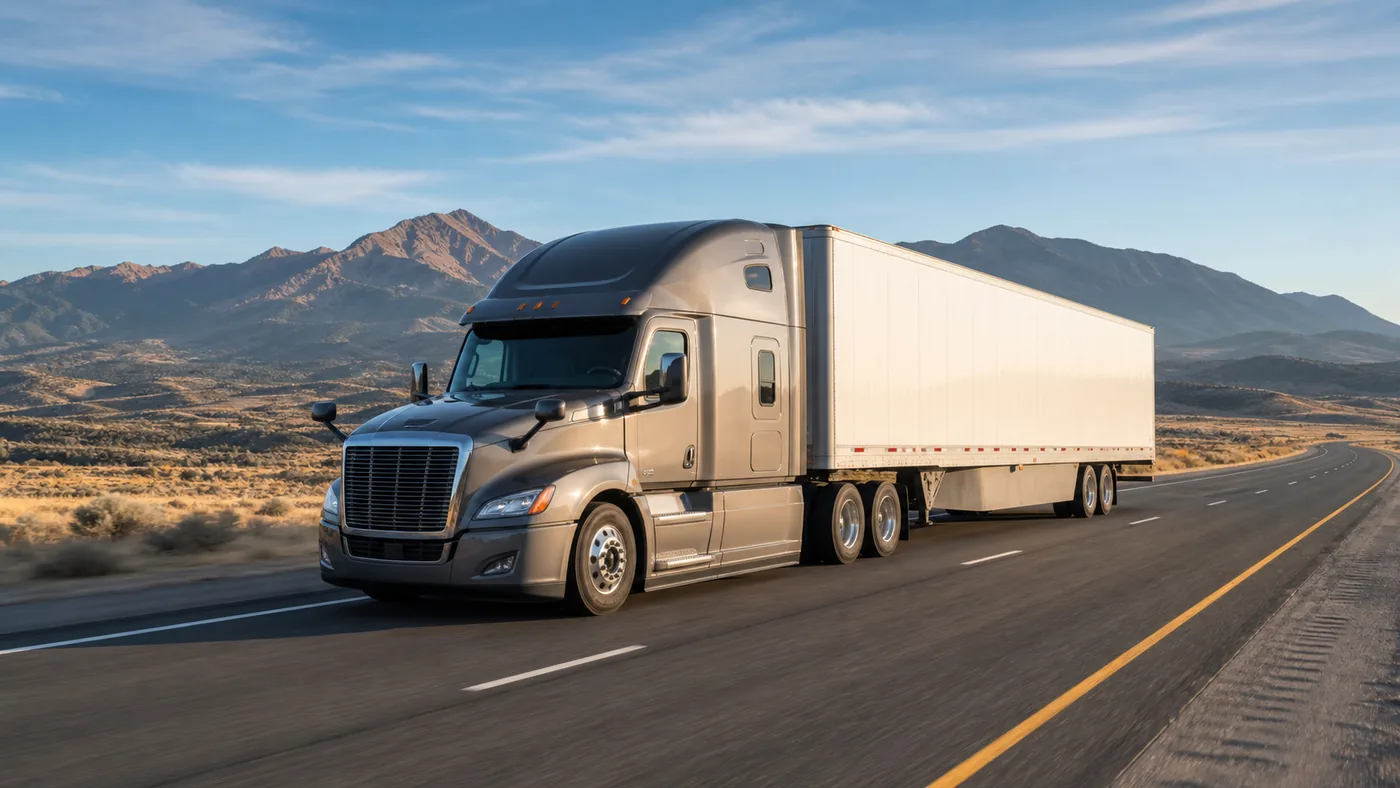
OTR means Over-the-Road.
An OTR truck driver transports freight over long distances rather than remaining within one city or a small local service area.
An OTR route may take a driver:
- Across several states
- From one side of the country to another
- Between major distribution centers
- Through different regions of the United States
- Hundreds or thousands of miles during a single trip
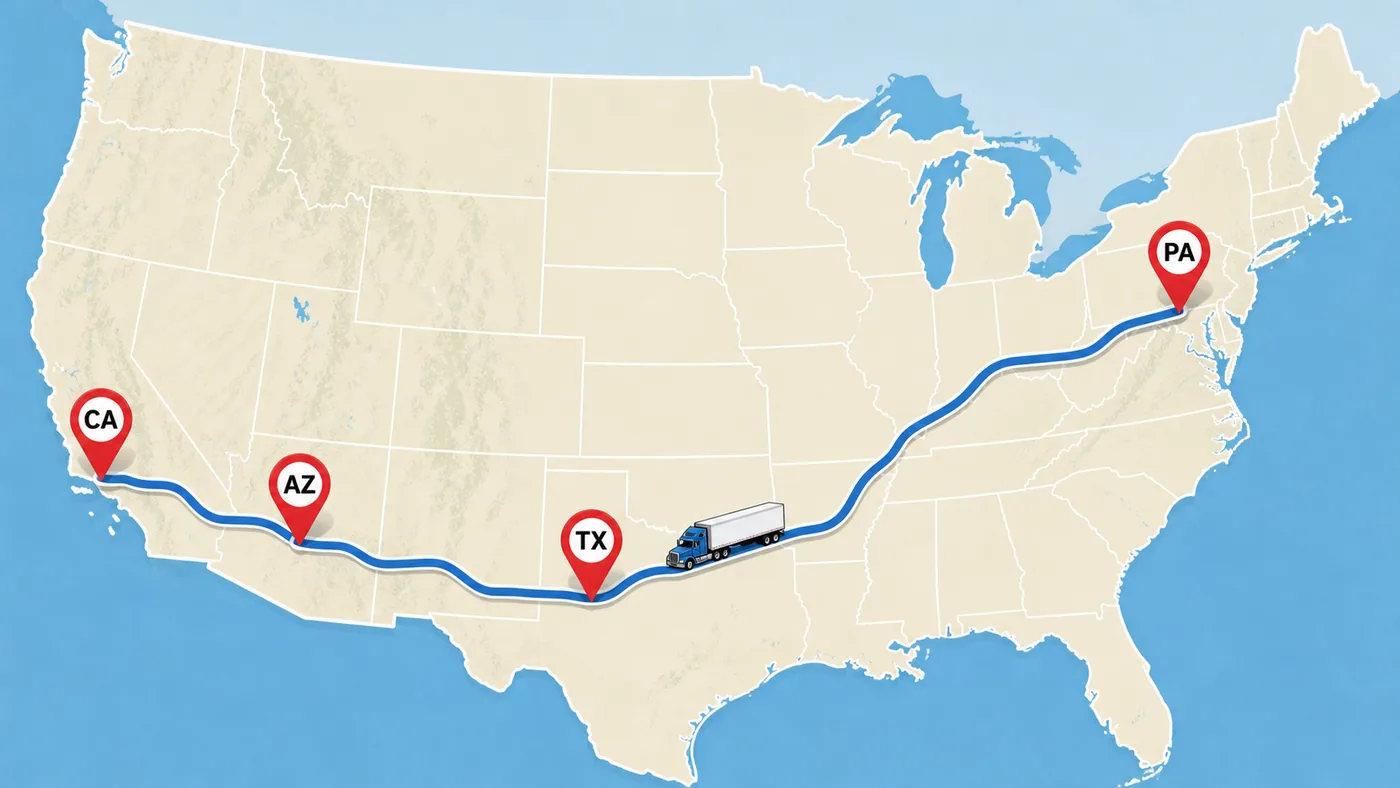
Unlike local drivers, who generally return home after their shift, OTR drivers frequently stay on the road for extended periods.
A driver might leave a terminal in Pennsylvania, deliver a load in Texas, pick up another shipment in Oklahoma, and then continue toward California or another part of the country.
There is no single federal mileage requirement that makes a job "OTR." The term is primarily used by the trucking industry to describe long-haul operations.
OTR driving is often associated with interstate commerce, although the legal definition of interstate transportation depends on the movement of the freight and not simply whether a truck physically crosses a state border. FMCSA defines interstate operations to include transportation across state lines as well as certain movements within one state when they are part of a shipment originating or terminating in another state or country.
How Long Are OTR Drivers Away From Home?
One of the biggest differences between OTR trucking and other driving jobs is home time.
OTR drivers may remain on the road for:
- Several days
- One to two weeks
- Two to three weeks
- Longer periods depending on the carrier and driver's schedule
Some carriers offer structured schedules, while others provide home time based on how many days or weeks the driver has spent on the road.
For example, an OTR driver might stay out for two weeks and then receive several days at home.
Other drivers may choose to stay on the road longer because they want to maximize their available miles.
The exact schedule depends heavily on:
- The trucking company
- Freight availability
- Driver preferences
- Route structure
- Customer appointments
- Location of the driver's home
- Company home-time policies
Anyone considering OTR trucking should pay close attention to home-time policies before accepting a job.
What Does an OTR Truck Driver Do?
The basic responsibility of an OTR driver is to safely transport freight from one location to another.
However, the job involves much more than simply driving down the highway.
An OTR driver's responsibilities may include:
- Performing pre-trip inspections
- Connecting and disconnecting trailers
- Picking up freight
- Delivering freight
- Planning routes
- Monitoring fuel
- Managing Hours of Service
- Using an Electronic Logging Device
- Checking cargo and trailer condition
- Communicating with dispatch
- Finding legal parking
- Navigating weigh stations
- Dealing with traffic and weather
- Maintaining shipping paperwork
- Performing post-trip inspections
Drivers must also plan ahead because a problem hundreds of miles from home can affect an entire delivery schedule.
Something as simple as heavy traffic, a closed highway, a full truck stop, or a long delay at a shipper can significantly change the driver's day.
What Does a Typical OTR Trucking Day Look Like?
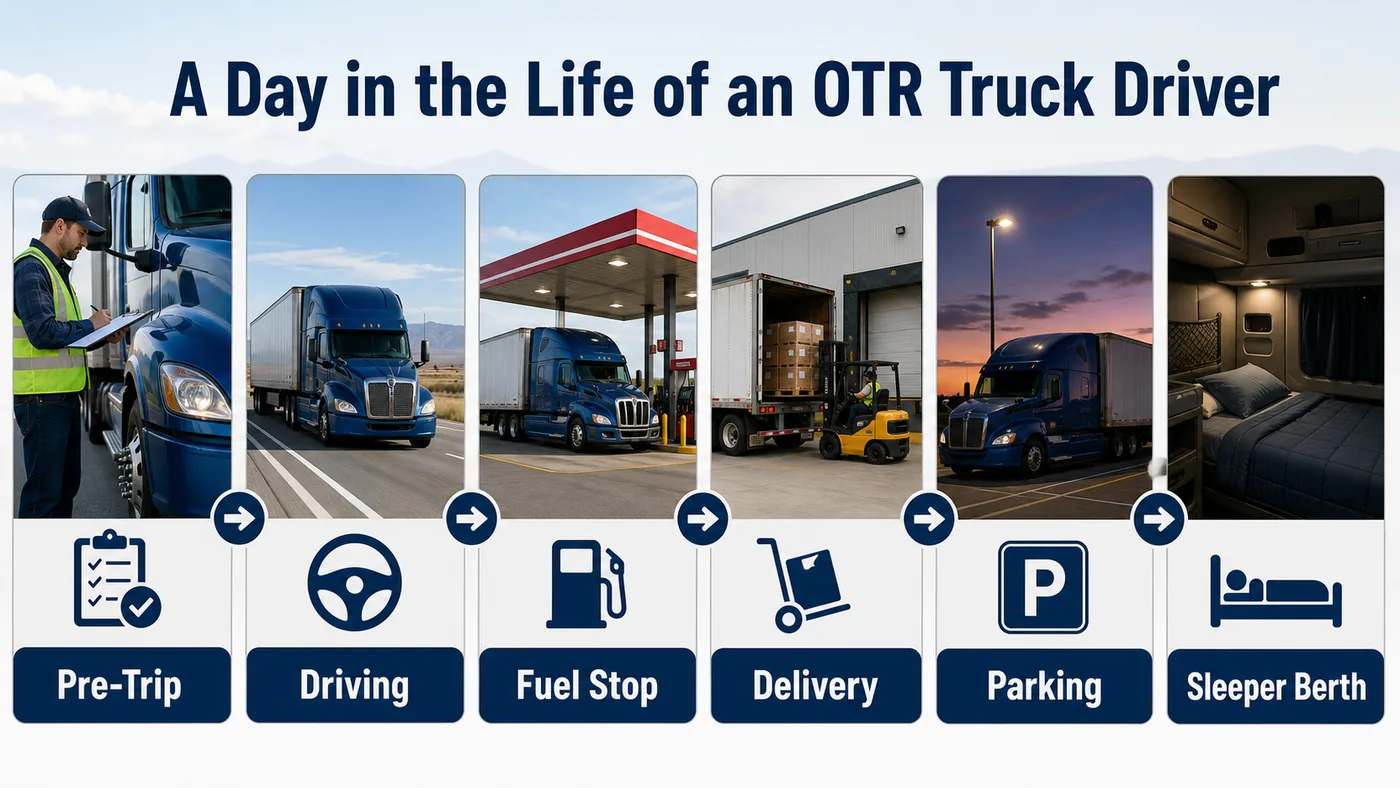
No two OTR days are exactly the same, but a normal day may look something like this.
Morning: Pre-Trip Inspection
Before driving, the truck driver performs a pre-trip inspection.
Important areas may include:
- Tires
- Wheels
- Brakes
- Lights
- Mirrors
- Fluid leaks
- Fifth wheel
- Air lines
- Electrical connections
- Trailer condition
- Cargo securement when applicable
Finding a problem before leaving is much better than discovering it on the interstate.
Starting the Route
After completing the inspection and checking the route, the driver begins traveling toward the delivery location.
During the trip, the driver must monitor:
- Traffic
- Weather
- Fuel level
- Route restrictions
- Hours remaining on the ELD
- Delivery appointment time
- Available truck parking
Fuel and Rest Stops
OTR drivers regularly stop at truck stops and travel centers for fuel, food, showers, rest breaks, and vehicle checks.
Fuel stops are often planned carefully because stopping unnecessarily can reduce productivity.
Pickup or Delivery
At a shipper or receiver, a driver may:
- Check in at a security gate.
- Receive a dock assignment.
- Back the trailer into the dock.
- Wait while freight is loaded or unloaded.
- Receive paperwork.
- Inspect the trailer or load.
- Leave for the next destination.
Some facilities can process trucks quickly.
Others may keep drivers waiting for several hours.
End of the Driving Day
When the driver's available hours are running low, finding parking becomes a major priority.
The driver may stop at:
- A truck stop
- Company terminal
- Rest area
- Customer facility
- Approved parking location
For many OTR drivers, the sleeper cab then becomes their home for the night.
How Many Hours Can an OTR Driver Drive?
Most property-carrying OTR drivers operating under federal Hours-of-Service regulations cannot simply drive for as long as they want.
Under the standard federal HOS rules, a property-carrying driver generally may drive for a maximum of 11 hours after 10 consecutive hours off duty. The driving must normally occur within a 14-consecutive-hour driving window after coming on duty.
Drivers subject to the standard rule must also take a 30-minute break after 8 cumulative hours of driving without a qualifying 30-minute interruption.
Federal regulations also include weekly limits. Depending on the carrier's operating schedule, a driver may generally be subject to a 60-hour/7-day or 70-hour/8-day limit. A qualifying 34-hour off-duty period can be used to restart the calculation under applicable rules.
There are exceptions and special provisions for certain operations and circumstances, so drivers need to understand which regulations apply to their specific work.
What Is an ELD?
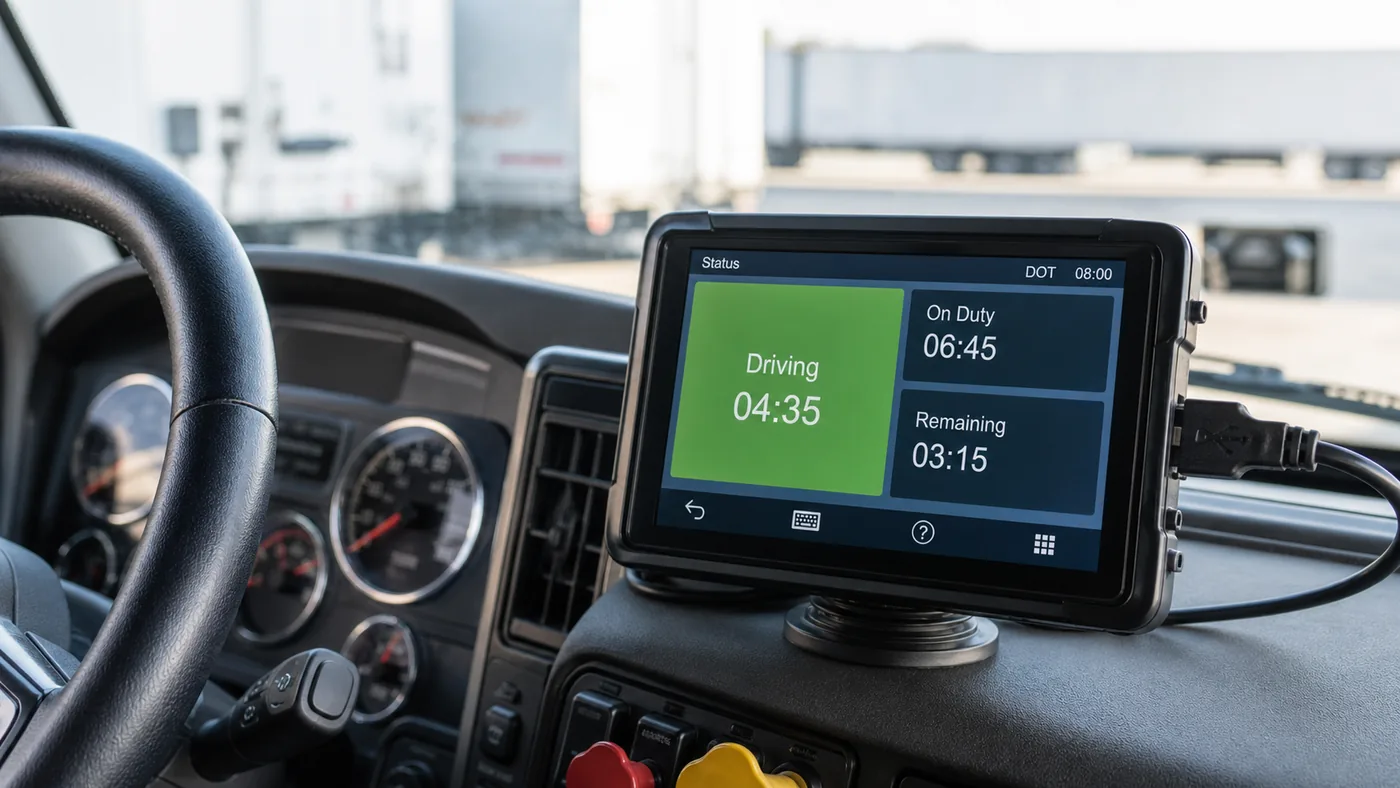
Most OTR drivers are also very familiar with the Electronic Logging Device, or ELD.
An ELD connects to the vehicle and helps record driving time and other duty-status information.
Instead of relying entirely on traditional paper logbooks, drivers can use the electronic system to track their Hours of Service.
The federal ELD rule generally applies to most motor carriers and drivers who are required to maintain Hours-of-Service records of duty status, although certain exceptions exist.
An OTR driver's ELD may display information such as:
- Driving time used
- Driving time remaining
- On-duty time
- Off-duty time
- Sleeper-berth time
- Previous duty records
Learning how to manage your clock effectively is an important part of becoming an efficient OTR driver.
What Kind of Trucks Do OTR Drivers Use?
Most OTR freight is transported using Class 8 tractor-trailers.
Because drivers may spend many nights away from home, OTR tractors commonly have a sleeper cab behind the driver's seat.
The sleeper area may include:
- A bed or bunk
- Storage compartments
- Refrigerator
- Microwave
- Power outlets
- Climate controls
- Curtains
- Cabinets
- Television or laptop setup
The exact equipment depends on the truck and company.
For OTR drivers, keeping the sleeper organized can make life on the road much more comfortable.
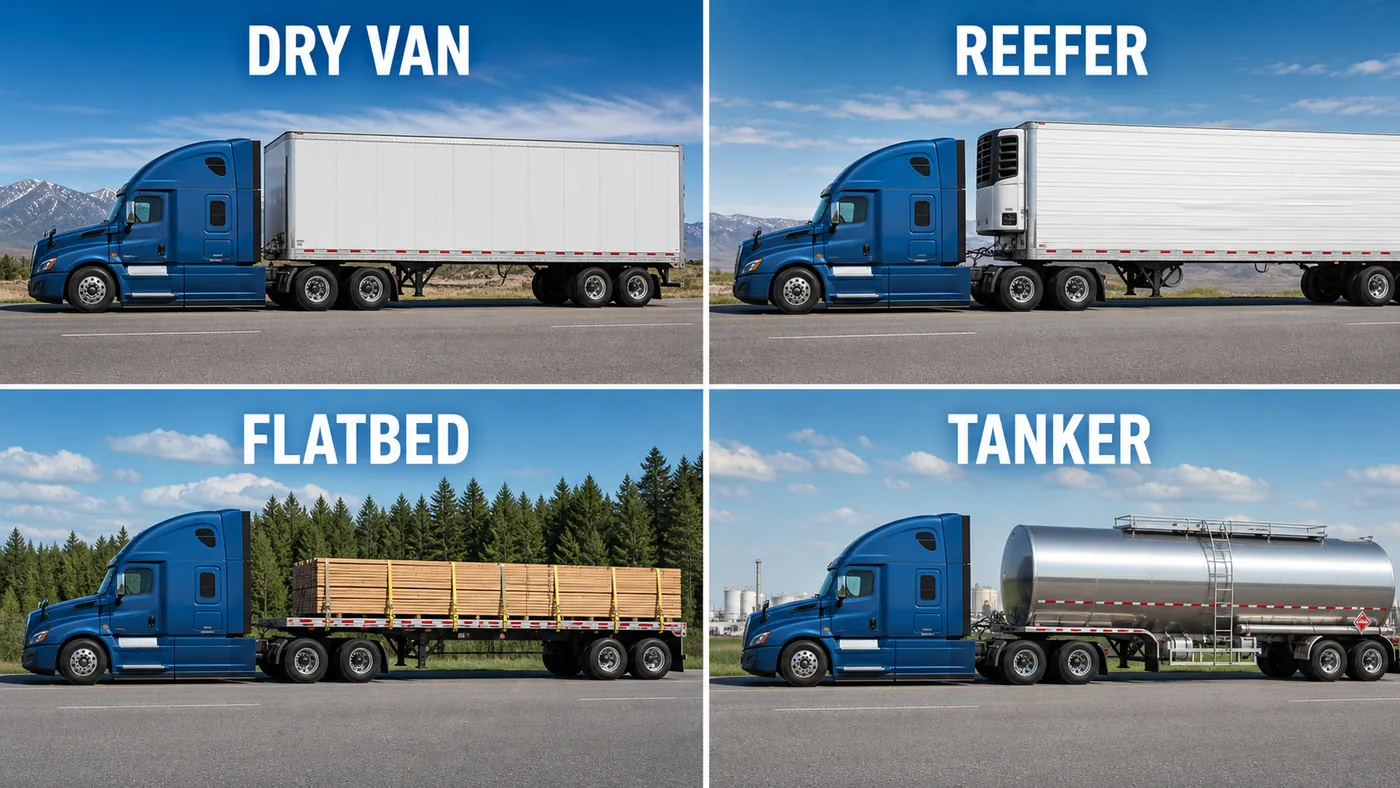
What Types of Trailers Do OTR Drivers Pull?
OTR does not describe a specific trailer.
It describes the type of long-distance operation.
OTR drivers may pull several different types of trailers.
Dry Van
A dry van is one of the most common trailers in trucking.
It is fully enclosed and commonly carries:
- Retail products
- Electronics
- Packaged food
- Furniture
- Manufacturing supplies
- General freight
Reefer
A refrigerated trailer, commonly called a reefer, can maintain controlled temperatures.
Reefer drivers often transport:
- Produce
- Frozen food
- Meat
- Dairy products
- Temperature-sensitive products
Flatbed
Flatbed trailers are frequently used for:
- Steel
- Lumber
- Construction materials
- Machinery
- Large equipment
Flatbed trucking often requires more driver involvement with cargo securement and tarping.
Tanker
Tankers transport liquids, gases, dry bulk products, and other specialized cargo.
Depending on the vehicle and cargo, special CDL endorsements may be required.
OTR vs. Regional vs. Local Trucking
One of the easiest ways to understand OTR trucking is to compare it with regional and local driving.
| Type of Trucking | Typical Operating Area | Home Time | Typical Driving |
|---|---|---|---|
| OTR | Large regions or nationwide | Days or weeks away | Long-distance |
| Regional | Several nearby states or one region | More frequent home time | Medium-to-long distance |
| Local | City or surrounding area | Usually home daily | Short-distance |
OTR Trucking
OTR offers the largest operating area.
Drivers may travel anywhere their carrier has freight.
It can provide significant highway experience, but it generally means spending more time away from home.
Regional Trucking
Regional drivers normally operate within a defined part of the country.
For example:
- Northeast
- Midwest
- Southeast
- Southwest
- West Coast
Regional schedules can provide a balance between long-distance driving and more frequent home time.
Local Trucking
Local drivers usually operate close to a home terminal.
Depending on the job, drivers may return home every night.
However, local work can involve:
- More city traffic
- More backing
- More stops
- More customer interaction
- More loading and unloading
There is no universally "best" option.
The right type of trucking depends on the driver's lifestyle and priorities.
What Is Life Like Inside an OTR Sleeper Cab?
For an OTR driver, a semi-truck is not just transportation.
For several days or weeks at a time, it can also become a temporary home.
Drivers commonly keep supplies such as:
- Clothing
- Bedding
- Bottled water
- Food
- Cooking equipment
- Personal hygiene products
- Laptop or tablet
- Phone chargers
- Work gloves
- Flashlight
- Basic tools
- Cleaning supplies
Some drivers prepare meals inside the truck instead of buying restaurant food every day.
Others install additional organization systems to make limited interior space more comfortable.
Keeping the sleeper clean and organized is especially important when you are living inside the truck for long periods.

How Much Do OTR Truck Drivers Make?
OTR driver income varies considerably.
Compensation may depend on:
- Experience
- Carrier
- Number of miles
- Freight type
- CDL endorsements
- Safety performance
- Bonuses
- Geographic region
- Solo or team operation
- Whether the driver is a company employee or owner-operator
Many company drivers are paid based on mileage, often expressed as cents per mile (CPM), although compensation systems vary.
Additional pay may sometimes be offered for things such as:
- Detention
- Layovers
- Extra stops
- Loading or unloading
- Safety bonuses
- Performance bonuses
The U.S. Bureau of Labor Statistics reported a median annual wage of $57,440 for heavy and tractor-trailer truck drivers in May 2024. This figure covers the broader occupation and should not be interpreted as a specific OTR salary. BLS also notes that long-haul trucking can involve drivers being away from home for days or weeks at a time.
Some OTR jobs may pay more or less depending on the carrier, experience, freight, mileage, and compensation structure.
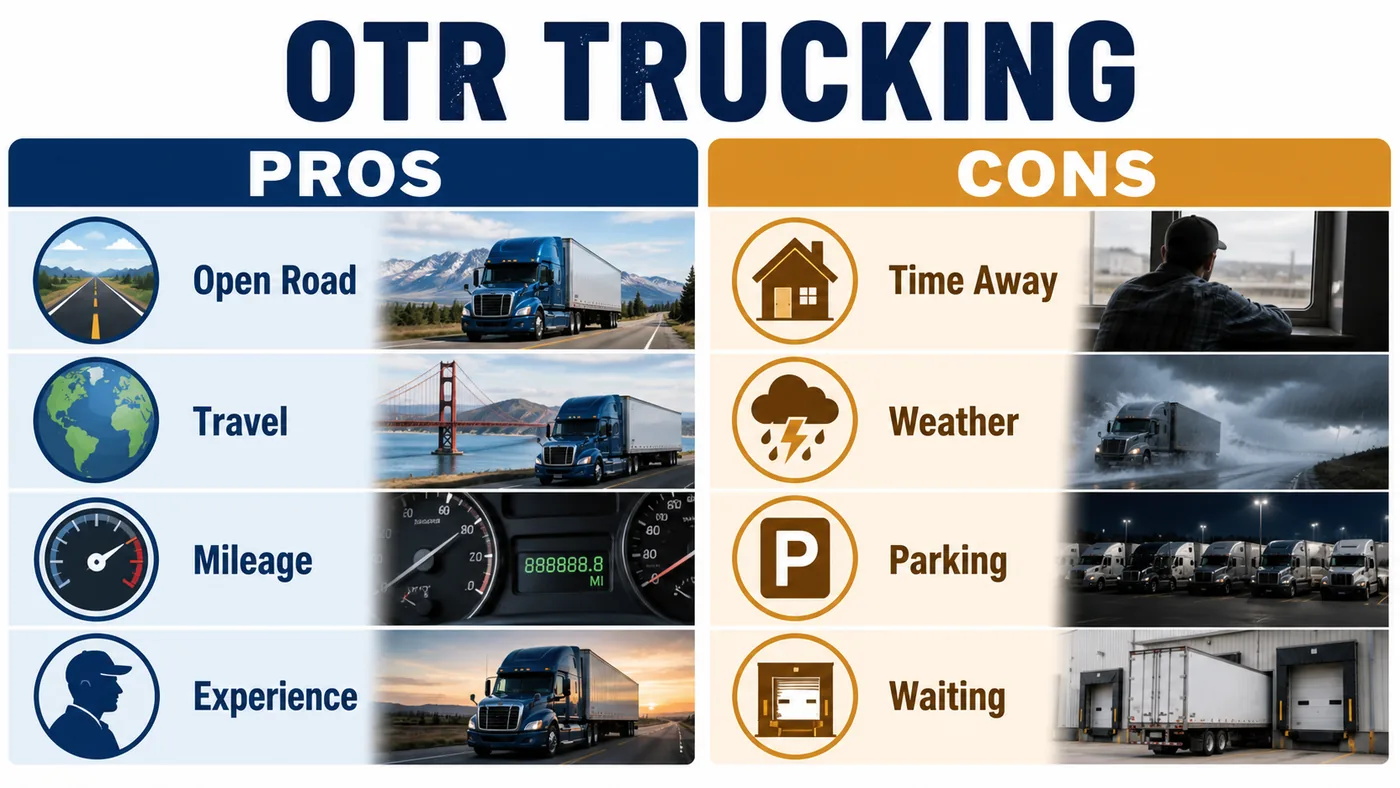
What Are the Advantages of OTR Trucking?
OTR trucking has several advantages that attract new and experienced drivers.
More Long-Distance Driving
If you enjoy highway driving and do not want to spend the entire day making local deliveries, OTR can be attractive.
Much of the job involves long stretches of interstate driving.
Opportunity to See the Country
OTR drivers may travel through dozens of states during their careers.
A driver could see:
- Mountains
- Deserts
- Large cities
- Rural areas
- Coastal regions
- Snow-covered highways
- Open plains
Of course, trucking is still a job, not a vacation, but the changing scenery is one feature many drivers appreciate.
Fewer Repetitive Routes
Some OTR drivers enjoy the fact that every week can be different.
One week may involve freight between the Midwest and Southeast.
The next may take the driver toward the West Coast.
Valuable Driving Experience
OTR driving can expose new drivers to:
- Different road systems
- Mountain driving
- Heavy traffic
- Winter conditions
- Distribution centers
- Truck stops
- Multiple freight customers
That experience can be valuable when moving into other trucking positions later.
Potential for High Mileage
Because OTR work focuses on long-distance freight, drivers may have opportunities to accumulate substantial mileage.
However, available miles depend on the carrier, freight market, dispatch, weather, equipment, and other factors.
What Are the Disadvantages of OTR Trucking?
OTR trucking also has significant challenges.
Time Away From Home
For many drivers, this is the biggest disadvantage.
Missing family events, weekends, holidays, and time with friends can be difficult.
Irregular Schedule
OTR freight does not always follow a normal Monday-to-Friday schedule.
Drivers may work:
- Early mornings
- Nights
- Weekends
- Holidays
Delivery appointments can influence when a driver sleeps and drives.
Finding Truck Parking
Truck parking can become difficult in busy areas, particularly later in the evening.
Drivers often need to plan where they will stop well before their available driving time runs out.
Weather
OTR drivers may encounter several types of weather during the same trip.
Examples include:
- Snow
- Ice
- Heavy rain
- Fog
- High winds
- Extreme heat
A route that begins in warm weather may end in a winter storm hundreds of miles away.
Long Periods Sitting
Professional truck driving involves many hours sitting behind the wheel.
Drivers therefore need to make conscious choices about movement, meals, rest, and their daily routine.
Waiting at Shippers and Receivers
Not every hour on the road is spent driving.
A driver may spend significant time waiting for freight to be loaded or unloaded.
This is often called detention time.
What Skills Does a Good OTR Driver Need?
Successful OTR drivers need more than basic truck-driving ability.
Time Management
Drivers need to balance:
- Driving hours
- Fuel stops
- Breaks
- Customer appointments
- Parking
- Traffic
- Weather
Poor time management can quickly create delivery problems.
Trip Planning
Before beginning a trip, an experienced driver considers:
- Distance
- Fuel stops
- Truck-safe routes
- Low-clearance risks
- Weight restrictions
- Construction
- Weather
- Mountains
- Customer location
- Parking options
A navigation app can help, but professional drivers should not blindly follow ordinary passenger-car GPS directions.
Backing Skills
OTR drivers frequently visit warehouses and distribution centers.
Some docks offer plenty of room.
Others can be extremely tight.
Good backing ability is therefore essential.
Independence
A dispatcher may be hundreds or thousands of miles away.
Drivers need to make responsible decisions on their own when facing road closures, weather, mechanical issues, or delays.
Patience
Traffic, waiting, construction, and unexpected problems are part of trucking.
Drivers need to remain calm and professional.
What CDL Do You Need for OTR Trucking?
Most drivers operating traditional OTR tractor-trailers need a Class A Commercial Driver's License (CDL).
A Class A CDL generally allows a qualified driver to operate combination vehicles meeting the applicable weight thresholds, subject to endorsements and restrictions.
Additional endorsements can expand a driver's employment opportunities.
Examples include:
- T — Double/Triple Trailers
- N — Tank Vehicles
- H — Hazardous Materials
- X — Tanker and Hazardous Materials
The endorsements you need depend on the vehicle and freight you intend to transport.
Is OTR Trucking Good for New CDL Drivers?
OTR trucking has traditionally been an entry point for many new CDL holders.
Some large carriers have structured training programs and hire drivers with limited professional experience.
OTR can also provide new drivers with a large amount of practical experience relatively quickly.
A new driver may learn how to handle:
- Interstate driving
- Different weather conditions
- Large distribution centers
- Truck stops
- Electronic logs
- Route planning
- Difficult backing situations
- Shipper and receiver procedures
However, new drivers should carefully evaluate an employer before accepting a position.
Important questions include:
- What is the pay structure?
- How many miles can drivers realistically expect?
- How often will I be home?
- Is detention paid?
- Is layover pay available?
- What equipment will I drive?
- Is there a training period?
- What happens if the truck breaks down?
- Are there driver-facing cameras?
- What areas of the country will I operate in?
- Is freight mostly drop-and-hook or live load?
Understanding the answers before accepting the job can prevent surprises later.
Solo OTR vs. Team OTR
OTR drivers may work as solo drivers or as part of a team.
Solo OTR
A solo driver operates the truck alone.
The driver is responsible for:
- Driving
- Inspections
- Deliveries
- Communication
- Trip planning
When the driver's available driving hours end, the truck normally stops.
Team OTR
Team trucking normally involves two qualified drivers sharing one truck.
While one person drives, the other may rest in the sleeper berth, subject to applicable Hours-of-Service requirements.
This arrangement can keep freight moving for more hours during a day than a solo operation.
Team operations are often used for:
- Time-sensitive freight
- Expedited shipping
- High-value cargo
- Long-distance deliveries
However, living in a small truck with another person for long periods requires good communication and compatibility.
OTR Trucking and Trip Planning
Trip planning is one of the most important habits an OTR driver can develop.
Before leaving, a driver should know more than simply the destination address.
A good plan may include:
Total distance
How many miles remain?
Available hours
How much legal driving time is available?
Fuel
Where will the truck need fuel?
Weather
Will the route encounter snow, storms, high winds, or extreme temperatures?
Terrain
Does the route include steep mountain grades?
Parking
Where can the driver safely stop for the night?
Customer information
What is the appointment time, entrance location, and check-in procedure?
Truck restrictions
Are there low bridges, restricted roads, weight limits, or other issues?
Good planning reduces stress and makes unexpected problems easier to handle.
Is OTR Trucking Worth It?
The answer depends on what you want from a trucking career.
OTR can be a good option for someone who:
- Enjoys long-distance driving
- Is comfortable being independent
- Can spend extended periods away from home
- Wants broad driving experience
- Does not need a traditional work schedule
- Is interested in traveling throughout the country
It may be less suitable for someone who:
- Wants to be home every night
- Has difficulty sleeping away from home
- Prefers a predictable daily schedule
- Does not enjoy spending long periods alone
- Wants a job centered within one city
Neither choice is wrong.
Truck driving includes many career paths, and drivers often move between OTR, regional, dedicated, and local jobs as their priorities change.
OTR Trucking FAQ
Does OTR Mean You Drive Across the Entire Country?
Not necessarily.
Some OTR drivers operate nationwide, while others spend most of their time within a large group of states.
The carrier's freight network determines where drivers normally travel.
Do OTR Drivers Sleep in Their Trucks?
Many do.
Modern OTR tractors frequently include sleeper berths that allow drivers to rest inside the truck.
Do OTR Drivers Come Home Every Weekend?
Some positions may offer weekly home time, but many OTR drivers remain away from home longer.
Always check a carrier's specific home-time policy.
Is OTR the Same as Long-Haul Trucking?
The terms are often used interchangeably.
Both generally refer to transporting freight over long distances and spending extended periods on the road.
Do OTR Drivers Load Their Own Trailers?
It depends on the freight and company.
Many dry-van and reefer loads are handled by warehouse employees.
Some jobs may involve driver-assist unloading, pallet jacks, hand unloading, or specialized cargo work.
Can New CDL Drivers Get OTR Jobs?
Yes. Some carriers hire new CDL graduates and provide additional training before allowing them to operate independently.
Requirements vary by company.
Final Thoughts
OTR trucking is one of the most recognizable parts of the American trucking industry.
OTR drivers transport freight across long distances, often moving between several states and spending days or weeks away from home.
The work offers independence, changing scenery, extensive driving experience, and the opportunity to become familiar with freight operations across the country.
However, it also comes with challenges.
OTR drivers must manage federal Hours-of-Service requirements, long periods away from home, changing weather, truck parking, delivery appointments, traffic, and life inside a sleeper cab.
For someone who enjoys the open road and wants to experience long-distance professional trucking, OTR can be an excellent way to build a career.
For drivers who place a higher priority on frequent home time, regional or local trucking may be a better fit.
Understanding those differences before choosing your first trucking job can help you find the type of driving career that matches your lifestyle.